Factionless vs. Fyodor

There’s a song in My Fair Lady where Eliza sings, “Words! Words! Words! I’m so sick of words!” All week I have had this line in my head, but replacing “words” with “work.” I had a fun but time-consuming design project compounded by a 200-page, very dry re-edit of a medical report that chewed through most of my nights. I put my foot down and didn’t let it chew through my weekend, however.

What that means is that I’ve been reading a lot in my “free” time, but it was nothing I’d ever read without being compensated, and nothing I’d wish on my worst enemy.

I did, however, finish the Divergent series. It was a fast read, it was nicely constructed and well planned from one book to the next. The only thing I remember wishing she’d elaborated on was the offhand mention that Edward wasn’t an entirely innocent victim in that whole stabbing thing. But beyond that, it was enjoyable.

The interesting thing for me is that I was reading this at home while I was listening to Crime and Punishment on my commutes to and from work. Unsurprisingly, this was a much denser undertaking, even though I was listening to rather than reading it off the page. There were a lot more layers to parse and I spent a lot more time thinking, “why did he write X instead of Y? Why did he create a nightmare about This instead of That?” and looking up the meanings of the names and so on. (I am continually fascinated by translations of literature. I harbor a mistrust that the translator has botched the job in terms of idiom or plays on words, or that I am missing some cultural reference that is hugely revealing or is a hilarious in-joke.)  Getting beyond all that, though, I found myself drawing lines between the dystopia of the past and the dystopia of the future.

I realize that these books are, for the most part, completely incomparable — different audiences, different genres, different intentions behind the writing, different everything. But bear with me.

All by itself, I find it an interesting commentary on human nature that futuristic dystopian fiction has had such a wave of popularity. Why do people gravitate toward books where Everything Is Awful, rather than Awesome? Is it because the world they live in shines by comparison? Is it because we like to read about people in hopeless situations? Is despair really more interesting than prosperity? It’s easier to create conflict, certainly, which does make more interesting reading.  So perhaps in an era when we are reasonably well off, we have to imagine dystopia to keep people reading. Dostoevsky’s horrific world, on the other hand, was smack-dab in front of him. His study on the psychology of people in a squalid and hopeless environment was utterly recognizable to his contemporaries; he didn’t need to devote time to explaining How Things Work in This World or What Led to This Horrible State of Things. (A good thing, as the book is plenty long without endless setup and world-building.)

The interesting comparison is that while Roth has to imagine the effect that her world would have on her characters, Dostoevsky could draw on actual observations that are archetypes now (and probably were when he wrote it) — the pious, the humble, the desperate, the drunkards, the lovers, the revolutionaries. You’ll find them all in Divergent, too, but built out in different ways.

All of which got me to thinking that recasting the world as it is today into despair is a market ripe for exploiting — dystopian 2010 Detroit, edge-of-dystopian Lake Mead-less Las Vegas, etc. I’m not sure I’m of the opinion that the majority of Americans actually LIVE in anything remotely resembling dystopia compared to 1860s Russia or Futureland Chicago, but I know there are malcontents out there happy to disagree–and, really, someone should capitalize on their dyspepsia, no?

Posted in Reading | Leave a comment

New Year, New Goals

Lots of new goals this year, lots of resolutions to fall down on. Or not, depending on the optimism level. Three are relevant to this blog:

1: Finish writing the book. I’m quite fed up with myself on this one. It has been a back-burner project for far too long. So I have mapped out a plan to finish it and hopefully get it sold—set myself deadlines and everything. We’ll see how it goes.

2: Read more. This may be a tad misleading, as I don’t really think I could read more than I do now—but the plan is to read less stuff for my job and more stuff that I actually want to read. I have three piles of Books To Read by my bed: one stack is material relating to my first goal; one is a pile of YA books I want to read so I can discuss them with my kid when he reads them, and one is a pile of fiction that I keep meaning to dig into and just never get around to. I suspect the house will be filthier than ever this year, but those piles are going to get smaller, by golly.

3: Reach out more. All this reading and writing, while fulfilling in and of itself, should not be my own personal cul de sac. My third intention is to get myself out there more; keep up with goodreads, blog more here, post more about my explorations on social media and maybe make some useful and interesting connections as a result. Or maybe just keep a running tally for my own smug purposes. Whatever!

So for the few of you who read this and are not spammers, I hope you’ll give me positive reinforcement with comments and critiques, suggestions and strictures, dialogue and diatribes!

To kick off the new year, I read the first three books of Lemony Snicket’s All the Wrong Questions series. Not as good as Unfortunate Events, but as I’m older than the target audience they were a breeze to finish and they gave me and the kid something to talk about. Now, I’m plowing through the Divergent series. Finished the first book over the weekend and started the second. I’ll reserve opinion til I’ve finished the trilogy—I’ll offer a small spoiler by mentioning that the kid informed me yesterday that there’s also a spin-off ebook and I’m not sure I’m willing to go out of my way to get it.

What did y’all think of Divergent? And what are you reading now? Or should I just go troll your goodreads accounts??

Posted in Fiction, New Year and Review, Reading | 4 Comments

Fifty CDs Later

It took a couple months, but I can now say I have conquered Atlas Shrugged.  It is a book I’ve thought about trying to read for years, but never felt I had enough time.  Then I found it on CD at our favorite used bookstore, and it was off to the races, as it filled my morning and evening commutes.

So, let’s start with the fact that lots of people hate Rand, for lots of reasons. It’s easy to understand some of that, and it’s fairly easy to see where other accusations have gone a bit astray, and it’s REALLY easy to see where knee-jerk reactions have just gone off the deep end and dumped the baby out with the bathwater.

Her writing is … not the best. I recognize that listening to a book read out loud is not the same experience as reading it off a page, and I’m not sure if the CDs made this aspect better or worse. Some of her stylistic choices are anvil-esque (that whole section about “blank out” in the radio address had me itching to hit the skip button), and some of her preaching does get in the way of her narrative (like, said radio address was three hours. I timed it, and she apparently did too, since it’s referred to as such in the book. Here on Planet Real World, the looters would have tuned out after about three minutes, and the Mr. Thompsons of the world would not have clustered around the radio listening; they would have been freaking the hell out and going on a rampage looking for how to spin it. Not to mention — at the end of the address, they are apparently all STILL STANDING UP staring at the radio. Seriously? I’d have plonked on the floor after the first hour or so.)  In other spots, her writing is comically clumsy — the whole action scene at the end rescuing John Galt was bad 30s film noir put on the page.

Her overall premise is appealing in some ways, though it runs into the same problems that all zealous -isms run into. It runs to absurd extremes, and she seems to labor under the impression that if given the option, everyone would operate the way she thinks they should. It’s unclear whether Rand thinks natural resources are there to be used up, or if she thinks that rational man will develop ways to use less of them so they last longer. All politicians are bad, and all capitalists are honorable men looking to create a better product. Well, no.  And her views on sex are a tad alarming, to say the least. There’s also little room for irrational emotional response. It’s also weird that the vast majority of her characters have horrible family lives — no parents, worthless siblings, unmarried, unhappily married, and no kids anywhere.  (Well, almost. There’s one family with two kids in the Colorado utopia.)  I can only speak from personal experience, but having a kid made a vast difference in my outlook on the world, and while I’m pretty sure I still fall squarely into the ranks of the workaholics, I also suspect there’s more to empathy and selflessness than Rand’s ideal world would include.

But here’s the real reason I won’t discount this book and so many others have. It’s a work of conservative fiction. There just isn’t much of that genre, and it gets smaller the farther you stray from the classics. Contemporary conservative fiction authors don’t tend to get throngs of admirers lining up around the block at book signings.  I’m not sure why this is. Do conservative readers prefer nonfiction? Do they keep a lower emotional profile that precludes fandom? Are they just older with bad knees and hate lines? Rand’s work does tend to be more treatise than treat, but there’s got to be something in there, given that she continues to appeal to new readers.

I suspect it’s the liberal-conservative issue that is at the root of the knee-jerk Rand haters.  She seems to be one of those writers who inspires extreme reactions — boundless enthusiasm or pure vitriol. (I find this interesting, because my own reaction was so very smack-dab in the middle, at the tippy top of the bell curve.) I suspect that liberal readers, confronted with a book that blasts the very core of their world view, respond as if faced with a base insult, rather than an alternative paradigm. I would posit that conservative readers of fiction are much more accustomed than liberal readers are to being confronted with the dichotomy of loving a book while despising the worldview that it (or its author) espouses, simply because there is so much more liberal fiction out there. And perhaps the problem with Rand is that her stories aren’t great enough to overcome that overwhelmingly hostile reaction to an alien viewpoint.

In any event, I’ll take Fifty CDs of Rand over Fifty Shades of Grey,  any day of the week.  How’s that for damning with faint praise?

Posted in Reading | 1 Comment

Things I’ve Read Instead of Writing:

I am poking along on my book endeavor.  Admittedly, I’ve done a fair bit of research in the time I haven’t been writing, but I’ve also done a fair bit of Other, as well.

I can’t remember if I’ve told this story before, and I’m not sure I’m crediting the right person with it, but I think it was Linda Ellerbee who was the first person I ever heard articulate this problem:  “You want a clean house? Tell me I have a work deadline. You want me to meet a work deadline? Tell me my mother is coming to visit.”

The hubs informed me the other night that I’m going to have to stop “McClellan-ing” this story and start using the army I have to fight the war I’m in. This is true. And when I went through my bibliography, I realized I’ve used a lot more sources than I originally thought I had. So that’s nice.

But in the meantime…

I’ve read Treasure Island and The Yearling with my kid. I listened while he read most of Robinson Crusoe aloud.  I have read countless reports for work.  I’ve read another slew of newspaper articles from 1871-1873, and chunks of books on the election of 1872, and about women, marriage, and society during Reconstruction.

I’m also part of the way through the Salterton Trilogy by Robertson Davies, which is delightfully grumpy.

Over the weekend, I read Auntie Mame aloud on the drive back from dropping our kid at camp.  I’d never read it before; only seen the movie. The movie does a fair bit of justice to the book, but the book is really worth picking up. It’s a nice blend of loving mockery of so many things, from clothing to attitudes to politics. I think it holds up rather nicely even if you don’t get a lot of the topical references.  (Thanks, Dad, for sending it to me!)

At the other end of the spectrum is an 1871 potboiler/cautionary tale called Mabel Lee.  It is hilariously overwrought, full of florid description and thickly veiled allusions to desecrated honor.  It also offers a rather pallid portrait of the Feminine Ideal — it appears the ideal is to be abducted by a man you don’t love, defend your virginal honor, and in doing so, go insane five minutes into the whole business–then upon being rescued some time later, spend a year in Paris regaining your senses. Miss Mabel starts out all frothy and childish and yapping about faerie queens and marriage, but imbued with a Deep Sorrrow around the eyes at her father having died around the time of her birth, with a pages-long fascination with assorted aesthetics — potential suitors paraded before her, women she knows, ribbons for bonnets, etc. She goes glassy eyed within one paragraph of realizing a man has done her wrong, and takes her sweet time getting over it.  (The Evil Abductor takes a bullet in the lungs when he struggles with his captors.)

And yet, I suspect I will be discussing this book at some length in mine, as so many details dovetail so nicely with my real-life story. So you-all can be looking for that — someday, I hope.

Posted in Reading | Leave a comment

What’s the Stuff Above the Subtext?*

* Spoken by one of my favorite actors, from one of my favorite movies.

One of the harder things for me to do in writing is to leave things out. It is unsurprising, with my journalism background, that I am very grounded in spelling things out, being as clear and direct as possible, with no room for misinterpretation or misunderstanding.  I can do it up to a certain point — if I am writing about a sad person, I might manage to cross out “Sadie was despondent,” and replace it with, “Sadie slumped over the table, her chin in her hand, staring bleakly at the wall.”  But it doesn’t generally occur to me to make the point that a person is sad by writing about all the happy things going on around them, with one reference to “Helllooo, Sadie! Engage, why dontcha?” (And when it does occur to me, it isn’t until the third or fourth rewrite.)

I have a deep and abiding respect for writers who can do that.  The kid just finished reading To Kill a Mockingbird, and probably half of what goes on in that book is implication and inference, and it is beautiful. It was funny to go through that book with him, though. I realized that being able to pick up on those cues stems from a situational awareness — something my kid appears to have in short supply.  He has a vague notion of time, a vaguer notion of geography — even his grasp of his own physicality seems in question at times, as he stumbles and bumps into people. He’s subtle as a semi truck.  And, of course, he’s 10, so his grasp of Depression-era Southern norms and mores is a tad weak.  Yet he was still able, at the very least, to pick up on the fact that he was Missing Something, and to ask about it.

He’s bumped into things like that before—he was three books into Lemony Snicket before he realized all the names were references to something else and started looking them up.  Even I’ve read a few books like that, where I knew there were in-jokes or cultural references I wasn’t getting. Sometimes I look them up, sometimes I ignore them.

I do wish I could figure out how to WRITE THEM.

In my first step toward that goal, I’ve committed to telling the kid vague stories, veiled to various degrees, at least once a day, and seeing if he can grasp what I’m NOT saying.  I watched my husband unwittingly pull off a great one last night. We were talking about buying the kid a bowling ball, and this story got shared:

“My brother Gary took me to buy a bowling ball at Woolco in Terre Haute.  We were in line behind a black couple, who had something very specific in mind that they wanted.  The cashier was being a jerk, kind of mouthy and obnoxious, acting like he knew what they wanted better than they did.  So they finally wrapped up their business, and we stepped up to the counter.  The cashier shook his head at us and said, ‘It’s always the blacks.’ My brother looked at him, looked at me, and said, ‘You wanna go somewhere else to buy a ball?’ And I said, ‘Yeah.’  So MacMillan’s Sporting Goods got our business that day.”

I asked the kid the next day, “So, why did Uncle Gary ask your dad if he wanted to go to a different store?” And the kid goes, “Because we don’t reward racism.”

1: Love that story.
2: Validated in having married well.
3: Pleased that the kid has decent values.
4: Delighted that the kid actually read between the lines (admittedly, they are pretty wide lines, but still, he did it).

Or rather, “The boy in the back seat mulled the story over. In the blue glow of the dashboard light, the woman squeezed her husband’s hand and smiled.”

Posted in Inspiration, Language | Leave a comment

If You Like Downton Abbey…

… You should read what I’m reading. Mr. Bicknell got me two Nancy Mitford novels for Christmas, and I ripped through them in a couple of days. Now I’m reading The Sisters, a biography of all the Mitford gals—Bright Young Things who ran around with Churchill and other British society types; one of whom ran off to Germany and became a big fan of Hitler (so if that winds up happening to Lady Edith, you heard it here first.)

So, I’ve had five days off, and I haven’t written a word—Well, that’s not true. I wrote a freelance piece on the Wizard of Oz.  But I haven’t written a word on my book. I should feel guilty about this, I suppose, but I don’t.  I prefer to think of it as resting while I Absorb Things.

Along with reading, I also watched several movies. Argo was better than I thought it would be. The Long, Hot Summer with Paul Newman was cheesier than I thought it would be.  Noises Off was hilarious and exhausting, and if you have film editor friends, you will have a great appreciation for the work done in it.  My kid is reading To Kill a Mockingbird, so we watched that movie again Friday. I’d forgotten how good both book and film are in their own right.

I sincerely hope that all this semi-historical material kicks me into a history-writing frame of mind. There’s always next weekend for settling in under the laptop!

In more exciting news, the Beatles magazine I freelanced for has been printed. I believe it will be in shops later this month.

In truly exciting news, Mr. Bicknell got a book cover! It’s quite lovely. We were very excited.

Posted in Doldrums, Inspiration | Leave a comment

Indian Summer

(A short story to kick off the new year, based on a snippet of a story in an 1872 newspaper.)

John Wheeler was 22 when he declared only death would part him from Mary Elizabeth Wright. He was 34 when he kept that promise.

The two were childhood sweethearts, living on adjoining farms in Virginia’s rolling hills. John would spend days in the fields with his father, and occasionally he would steal a few moments to visit with Mary as the sun was setting. They would share secret smiles at church on Sunday. In the winter he walked her to school.

As they got older, she would tease him.

“Do you love me?”
“More than life.”
“Am I pretty?”
“More beautiful than Indian summer.”

******

Then the war came, and as soon as John was old enough, he went off to fight, signing up to defend the Confederacy and its rail lines from advancing Union troops. He wrote Mary long letters in his head, and short ones on whatever paper he could get. He told her about the cold, the heat, the other boys he was encamped with. He didn’t tell her about the hunger or the pain. He knew everyone felt that. There didn’t seem much point in blabbing about it.

When he finally came back home, Mary was waiting. She was thinner, but so was he. She had been sick. He had been broken. But when she smiled at him, he felt whole, and when he smiled back, she felt stronger. They were married in the summer, a year after the war ended. They were older, wiser. They had been through a lot and figured whatever came next would be easier to take on together. They knew better than to wax poetic anymore. Life was too short, words too flimsy.

“Do you love me?”
“With all my heart.”
“Am I still pretty?”
“You are beautiful.”

******

But it wasn’t easier. Reconstruction wasn’t easy on anyone. They lived on his father’s farm. His father had died; one less mouth to feed but one less pair of hands to do the work. There was no money. John scraped in wheat harvests that barely paid for the expenses of growing them. Mary coaxed a garden along. John loved her for it, hated himself for not providing more. The winters were cold. They needed fuel. She needed medicine. She deserved better. She deserved a little hope. For that matter, so did he.

“Do you love me?”
“Of course I love you.”
“I’m not pretty anymore.”
“Of course you are. Don’t talk that way.”

******

When the baby came, they were joyous. She was a strong, healthy little thing, a springtime baby, and she looked like her mother. Still, John couldn’t help wishing she had come along a little later, that they’d had a little more saved up. He tried to believe it was a sign; that things were going to turn around. But he couldn’t keep the worry out of his mind, out of his eyes, even as he smiled at Mary, lying exhausted in the bed.

“Do you love me?”
“I’ve never loved you more.”
“If you say I’m pretty, I’ll know you’re a liar.”
“You’re the second-most beautiful thing I’ve ever seen, next to Little Miss, here.”
“What do we name her?”
“How about Lily, for your mother?”
“How about Ruth, for yours?”
“Lily Ruth. Miss Lily Ruth.”
“Lovely Lily Ruth.”

******

The baby got bigger, but things didn’t get better. Mary was still too thin, too peaked. He worried about her, but there was nothing he could do. John knew a man who had a still, and he traded corn for corn liquor. Sometimes he drank while he was out behind the plow. It made the time go faster. It made the pain go away. He didn’t feel as ashamed of himself. And it made him more fun with Lily. He’d go in and giggle with her. He knew Mary could tell, but she never said anything. She just sighed and went on with whatever she was doing. He knew she was watching; knew she was afraid he’d drop the baby or something careless. But he never did. He drank to take the edge off, not to get lost.

At night, they would lie together in the narrow bed, the windows open to let in what breeze could be found in the sultry night air, listening to Lily breathing in her crib. He would put his hand on Mary’s flat belly and wish it were rounder before rolling over, turning his back so he could drift off with his own thoughts.

“Do you love me?”
“You know the answer to that.”
“Do you still think I’m pretty?”
“You know that too.”

******

They never talked anymore. Whenever they tried, it ended in a fight, and John thought silent parents were better for Lily than screaming ones. He drank all the time now; at every meal. It was the only way to get through a day. When Mary would bring his dinner pail and a dipper of water, he would wait until she’d left to fish the flask out of his hip pocket. He would polish that off, and that kept him numb until supper, when he’d take his next pull.

One night when he came in, the bottle was empty. It hadn’t been that morning. He knew, because he remembered thinking there was just enough to get him through to next afternoon, when he could get some more. Mary was leaning over the stove, her hair in her face, languidly stirring something. He yelled. She snarled. He banged his fist on the table and advanced toward her, menacing. Lily fled the house, Mary yelling after her to go to Grandmother Lil. He was right on top of Mary now, glaring down at her. She glared back, stuck her chin out at him.

“Do you love me?”
“What do you think?”
“I think you love that bottle more. And I can see why. Pretty sure I will, too.”

It happened before he realized what he’d done. His arm flew out and the bottle in his hand swung back, a giant, awful pendulum, stopping when it connected with the side of her head. She crumpled to the floor without a sound.

He was mute with shock. His first thought, in all its ridiculousness, was to wonder why the bottle hadn’t broken. Then he was on his knees, grabbing Mary’s hands, shaking her, patting her cheeks. The worry lines were not visible in her now-slackened face, the angry pinch between her eyebrows was gone. She was his girl, his wife, his daughter’s mother.

“Mary, wake up. I love you. You’re beautiful. Just wake up.”

He felt her wrist. Nothing.

She was gone. And Lily would be back any moment.

John panicked. He grabbed his billfold and fled.

                                               Part Two

 Benjamin Newland leaned against the counter of the general store, wiping the dust from the glass with his shirt cuff. He was dawdling, waiting for Ginny Sullivan to ring up his purchases. She handed him some packages neatly wrapped in paper and twine, along with his change, and gave him her usual twinkling smile, slapping lightly at his wrist when he flirted back, both of them knowing it meant nothing.

“Get you anything else?”
“Only if you’re available.”
“Get on with you. Go feed your horses, Benjamin.”

 ******

Benjamin had lived with the dust and heat of New Mexico Territory for more than 15 years. He had been born on the train to Trinidad, Colorado, as John Wheeler shuffled off his old identity; the name chosen on a bumpy stagecoach to Santa Fe. Newland was obvious. He chose Benjamin for the biblical son of Rachel, the son of pain.

But he hardly ever felt that old pain anymore. He had stopped drinking, prayed for forgiveness, atoned as best he could. As dry as it was, he never got the old thirst. That was long over. He couldn’t even stand the smell of liquor anymore. But he dreamed about Lily occasionally. At first they were terrible, crystal sharp images of the daughter he’d left, piercing things that left him seeing her face every time he blinked. But over time the dreams faded until it was a faint image of a girl that could have been any girl. He forced himself to stop thinking about her. She was better off without him. He had destroyed her life when he destroyed her mother. He had no right to go barging back now. He was generally at peace here. He had what he needed, and nothing extra to get in the way.

“Get you anything else?”
“How about a little peck on the cheek?”
“Get on with you. Go pick your horses’ hooves, Benjamin.”

 ******

His life now was a solitary one. He’d grown older, and the sun had turned him wrinkled and brown. Another permanent side effect of his trip west was to go bald; whether it was stress or age, he didn’t know, but it meant he wore a hat almost constantly, sometimes even indoors from forgetfulness. He kept the livery stable in town; looked after horses and kept stockpiles of hay. He did his best to keep the rats down, and would occasionally look the other way when some fellows needed a place for a stag show. It wasn’t a gentleman’s life, but it was a living.

And it let him pass the time with Ginny Sullivan. Gray-haired and round-faced, Ginny was a widow about his age; she had taken over the store when her husband died after only a year out west. Benjamin wondered if Mr. Sullivan had been somehow involved in that Lincoln County business, but Ginny never said and he never asked. She had stuck it out a couple years now, and become a savvy businesswoman. The store had been one of the first buildings to have glass windows, and Ginny never wanted for coal in the winter. She was fat and happy. Her eyes twinkled behind spectacles nigh as thick as her waist, when she wasn’t squinting to read.

“Get you anything else?”
“A seat by the stove to spend the winter?”
“Get on with you. Go blanket your horses, Benjamin.”

 ******

He enjoyed visiting with Ginny. She was so wide she rolled her hips a little when she walked. He liked it. He’d had enough of rib cages and cheekbones and bony knees after the war. Sometimes he’d buy her penny candy as a joke and she’d suck on it while they talked. She was chatty, but not nosy. She was cheerful, but he could sense the sorrow behind it. He assumed it was losing her husband, but he didn’t ask. There was an unwritten rule out here that you didn’t talk too much about people’s histories, and that suited them both just fine.

“Get you anything else?”
“How about a buggy ride after you close up here? The spring flowers are out.”
“Get on with you. I have washing to do.”

 ******

Slowly, they realized the comfort they had found with each other. She accepted that buggy ride, he accepted an invitation to dinner. She balanced his books for him, he patched her roof. They played cards through the coldest parts of the winter. Eventually, it just made good sense that they’d get married.

“Get you anything else?”
“How about a ring?”
“I don’t know as I’m smitten with you.”
“I don’t need smitten. I need solid.”
“Well, I am that. I can make the floors shake.”
“Aw, you’re pretty as Indian summer.”

She gave a start and made a strangled noise in her throat when he said that. A sharp look in his direction, then she shook her head.

“Get on with you. Go muck your stables, Benjamin.”

 ******

The next time, he came in with a ring. He’d bought it off a Navajo who happened through town, and he presented it to Ginny. She pretended to be annoyed that he’d spent the money somewhere other than her store. Then she gave him a long, searching look, her nose almost touching his.

“Get you anything else?”
“Just a marriage paper.”
“Nothing from the bar over’t the saloon?”

Now it was his turn to be surprised. He hadn’t had a drink in over 10 years, certainly not since they had met. Why would she ask that? He shook his head, bewildered. She folded her arms, gave him a strange smile.

“Get on with you. Go soak your head, John Wheeler.”

Mary Elizabeth Wright Wheeler had woken up in her bed with the doctor leaning over her. She remembered the fight, but not much else. She waited for him to come home for a while; moved in with her mother while she recuperated. Eventually she gave up and decided he was gone for good. She’d sold his farm and gone north to Philadelphia, to see a doctor there about the headaches that wouldn’t go away. While she was there, she met Henry Sullivan, dry goods merchant. He was cheerful and prosperous, and called her Virginia because of her accent. It was fine by her; she couldn’t stand to be called Mary anymore. He was safe and a good provider, so when he asked her to marry him, she said yes, and became Ginny Sullivan for good. Henry had given Lily the best — good schools, pretty dresses, a place in society. Lily met a nice boy, and was married in New Jersey. When she’d gone east, they’d come west. But Ginny didn’t know what to make of the fact she’d landed right across the street from her first husband. Was it a sign? A warning? Or just one of those things?

“Mary-Gin, I guess you’d as soon not see me again.”
“Johnny-Ben, you’d guess wrong. I’m rather fond of this New Mexico you.”

 ******

John Wheeler had been 22 when he declared only death would part him from Mary Elizabeth Wright. Benjamin Newland was 62 when he kept that promise for the second time—dying of old age, in his bed, with Ginny Newland holding his hand.

Posted in Fiction | Tagged | 1 Comment

The First Step Is Realizing You Have a Problem

I have been procrastinating on the nonfiction book. Well-Intentioned Husband asked why last night and made me actually think about the answer. I finally realized (perhaps rationalized) that my sticking point is the lack of a first-rate intelligence, per F. Scott Fitzgerald. As I’ve mentioned here before, he said the true test of such a thing is “the ability to hold two opposing ideas in mind at the same time and still retain the ability to function.”

I’m failing at that.

It turns out that I have two very distinct views of writing — unsurprisingly, they fall into “fiction” and “nonfiction” — which isn’t unusual, is fairly understandable, and is probably the way nearly everyone else would divide writing as well.

I don’t have any trouble getting things going with fiction. I can make up whatever I want, create characters in any image I choose, hear their voices, pattern them on people I know or wish I knew.

Up to now, I’ve never had any trouble with nonfiction, either. After all, I worked in news for a gobzillion years. I wrote breaking articles, I wrote features, I took the slant out of more copy than Xerox. I could look at a situation and recount it clearly without imposing too much of my own bias, unless that’s what the editor wanted from me.

But now I’m in this nether world where I want to write a nonfiction book about a situation where I don’t have all the pieces and can’t see into every corner. I have the facts. I have the outline. I have a kickass narrative structure and rip-roaring sequence of events.

What I don’t have is any damn characterization what-so-farking-ever.

In fiction, this would not be a problem. I could say, “Oh, I know from the facts I do have that Main Character A is a lush. And he beats people up. Ergo, he is a mean drunk, and he was probably a lot like That Certain Insane College Boyfriend, so I will write him that way and give him that personality, but with a dash of Super Rational and Funny Husband to mitigate some of the crazy and make him a wee bit more likable.”

But this is a nonfiction book. So I feel that everything in it should be verifiable, cited, ironclad — and I have exactly zero documentation on which to build any of these folks’ personality or attitude. I know Main Character A was a mean drunk — but was he a bear or a snake? Did he bluster and threaten and stomp around, or did he just glare at you from a corner and strike without warning? I have my suspicions, but I DO NOT KNOW.

I suppose I could write it as a really long news story; a distant, formal, third-person, “He said this, they did that” recitation of fact without speculating much on personality or character. But I would bore myself to tears taking that approach, and I certainly wouldn’t wish it on any readers. So that will not be happening.

What will be happening? No idea. That’s what this weekend is for. But any advice would be welcome!

While I’m doing that, you should read the link below, because it is very interesting for writerly types. Also for readerly types, and for types who secretly think that the Harry Potter books were awfully long for so little action (spoiler, you will find yourself validated, sort of).

http://www.slate.com/articles/arts/culturebox/2013/11/hunger_games_catching_fire_a_textual_analysis_of_suzanne_collins_novels.html

Posted in Doldrums, Nonfiction, Personalities | 1 Comment

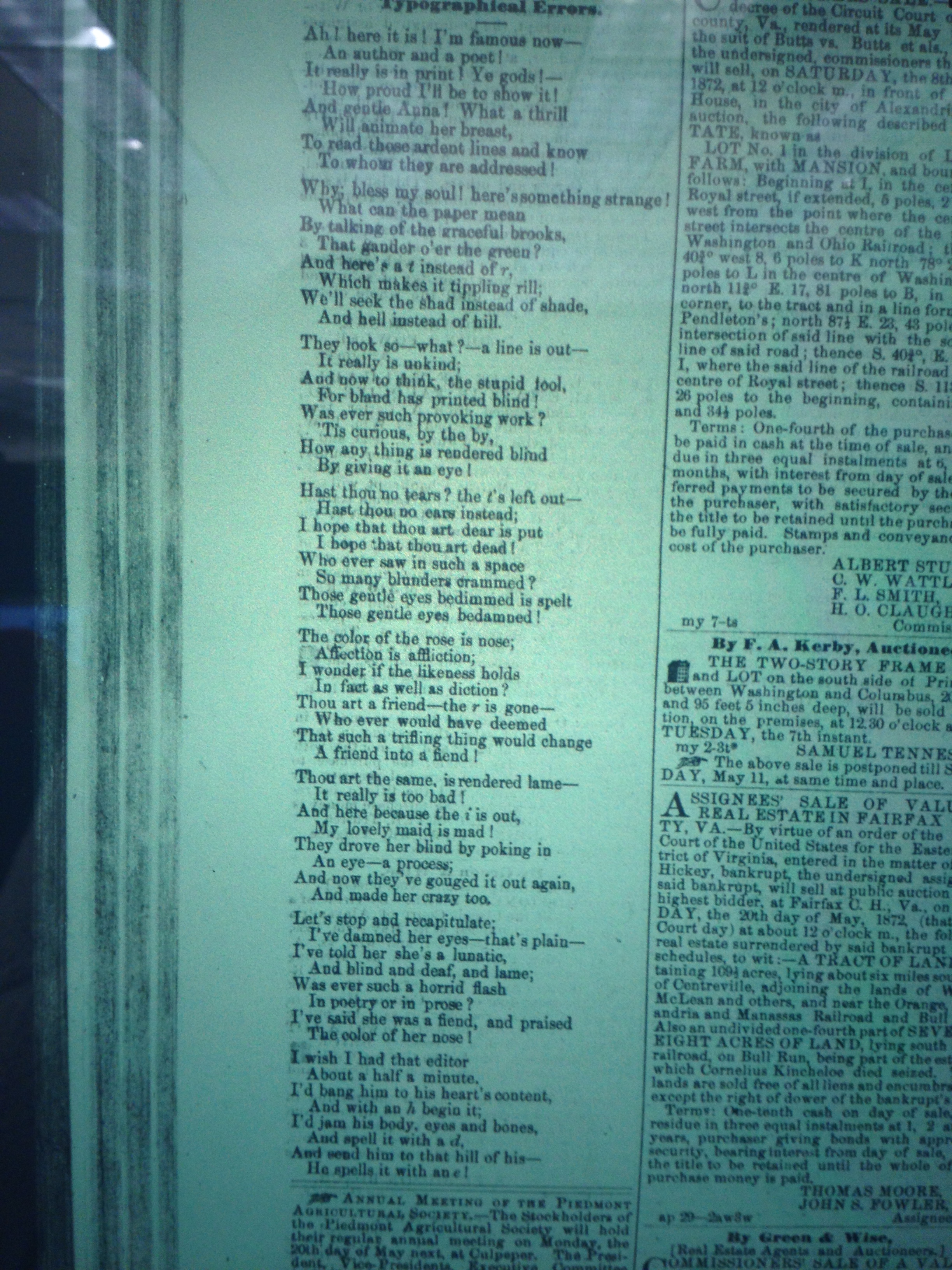
1872 Alexandria Gazette

Click for a larger view.


photo-5

Posted in History | Leave a comment

News, Both Fresh and Dated

Between vacations, the end of the fiscal year at work, and a pretty dramatic paradigm shift in my own writing-for-fun, I’ve been neglecting ye olde writing blog again.  Time to fix that.

First: I am pleased and proud to announce that through absolutely no doing of my own, I can now say I belong to a family of authors.  My father’s book about Theodore Davis has been out since July, and my husband’s book about 1844 will be out in autumn 2014. (Meanwhile, go check out his blog.)

Second: I got a critique back on the first page of my middle-grade novel.  Wanna know what the big criticism was? “I don’t think you need this rhetorical question here.” That was it. Aside from that, I got two compliments and an “I’d definitely keep reading!” Unfortunately, that does not translate into, “Please send me your book for consideration,” but it was an ego boost nonetheless and perhaps I will send it out.

Third: I’m not as invested in that as I was, for a couple reasons. First, it occurred to me that I need to be able to tell an agent/publisher that I’ve got blurbs/reviews/marketing lined up, and I don’t. And I am not sure I have the time or energy to line them up. I certainly don’t have the enthusiasm, because now I’m on a new voyage, with a different boat, in a whole ‘nother ocean.

You guys, I’m going nonfiction, in a big way.

First, I am doing freelance writing on pop culture. I turned in my first assignment today, and I am reasonably confident I’ll get tapped to do more as time goes on.

Second, I’m researching a rip-roaring tale from the 1870s that is an exciting story with great potential. More on that as I get down to the actual work.

It is funny, the difference in these two worlds. As I go along on the research, I am also looking at it with an eye toward marketing in the long run. But as I go along on the research, I also feel a little bit like Ulysses resisting the sirens.  I have to tie myself to the mast to stay on track.

It usually starts with me saying something like, “Oh, I need to find out when so-and-so got married.” So I go look for a census. And while I’m there, I find another familiar name, and I look up how they tie into the story, and then I find out some distant relative of theirs invented rubber bands or something, and the next thing I know I’m six rabbit holes in and only about three feet from the center of the earth, learning all about vulcanization, which has absolutely nothing to do with what I’m actually working on.

I’m having a great time with it, needless to say.

Posted in Nonfiction, Process, Shout-outs | Leave a comment